R-77-1 (RVV-SD)
R-77
Russia's active-radar medium-range missile. Its lattice fins are its most distinctive choice — and a trade with unusually sharp costs and benefits.
- Origin
- Russia
- Status
- In Service
- Introduced
- 1994
- Manufacturer
- Vympel
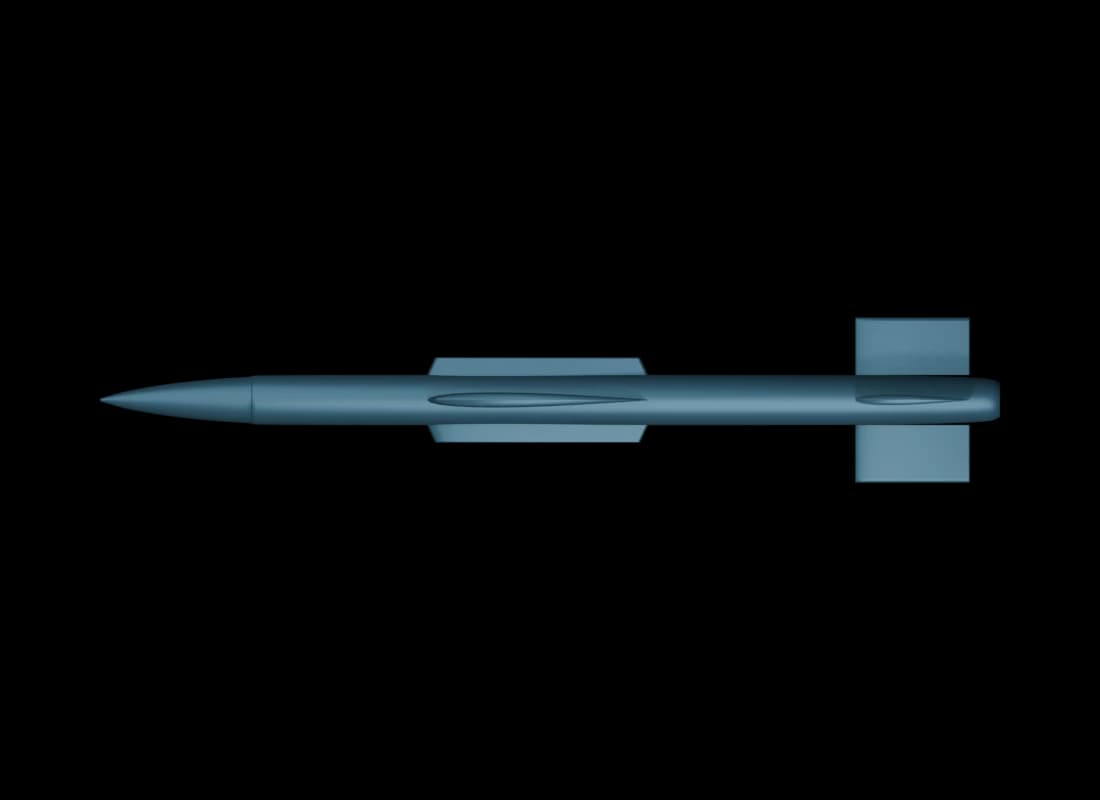
Overview
The R-77 was the Soviet answer to the AIM-120, entering service in 1994. It belongs to the same generation — active radar seeker, inertial midcourse, fire and forget — and matches it in basic capability, differing in detail and execution.
The most visible difference is the lattice control surfaces at the tail: a grid of small cells rather than flat panels. The trade is unusually sharp in both directions; see below.
It should be said that the R-77 has long faced the same issue as other advanced Russian weapons: fielded numbers and availability fall well short of the paper figures. Production capacity, funding, and export priorities together determine how densely it is actually carried — something no specification table shows.
Design
The lattice fins have real advantages: far better efficiency at high angles of attack, since a grid does not stall the way a flat panel does, and they fold compactly, helping with internal bays and dense loadouts.
The drawbacks are equally real: substantially more drag, especially transonically, which eats directly into range. That is why the later R-77-1 reverted to conventional planar fins — a design choice overruled by its own successor, which is the most honest verdict available.
The model here approximates the lattice with an equal-area flat surface. The grid structure itself is beyond what the parametric lofting pipeline can express, as noted in the spec.
Timeline
Enters service
R-77-1 reverts to planar fins
Lattice fins dropped to cut drag and extend range — a design choice overruled by its own successor.
Variants
- R-77Reserve
The lattice-fin configuration.
- R-77-1In Service
Conventional planar fins with greater range; the current standard.