B-2A
B-2A Spirit
The only stealth flying-wing bomber to enter service. Twenty-one were built, at a unit price high enough to reshape the entire procurement plan.
- Origin
- United States
- Status
- In Service
- First flight
- 1989-07-17
- Introduced
- 1997-04-01
- Manufacturer
- Northrop Grumman
Overview
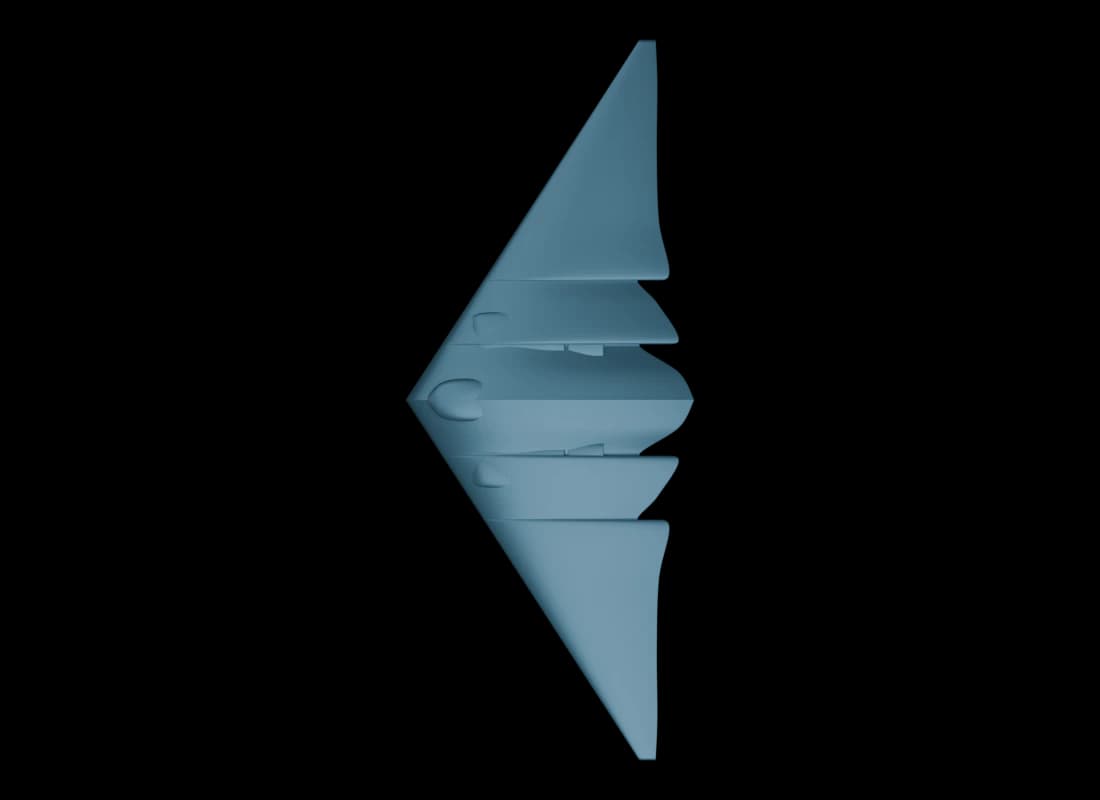
The B-2A is a product of the late Cold War, designed to penetrate Soviet integrated air defences and deliver nuclear weapons. It pushed the flying wing and low-observable design to the limits of what was then engineerable: no vertical tail, no conventional fuselage, the whole aircraft one lifting surface, with four engines buried in the wing and both inlets and exhausts on the upper surface, shielded by the airframe itself.
The original plan called for 132 aircraft. After the Cold War ended that was cut to 21, one of which was lost in a crash on Guam in 2008. Cutting procurement from 132 to 21 meant amortising the development bill across a twentieth as many airframes — which is where the frequently quoted "two billion dollars each" comes from, and the key to reading it: that is not what one costs to build, it is an artefact of how the cost was divided.
Design
The flying wing is itself the stealth design. With no vertical tail there are no corner reflectors; the leading and trailing edges are aligned into a small number of parallel directions, so radar returns concentrate into a few narrow angular sectors instead of scattering everywhere. The sawtooth trailing edge exists precisely so that every edge stays parallel to one of the two leading edges.
The cost is directional stability. With no fin, yaw control comes from split drag rudders at the wingtips — upper and lower surfaces at the same station opening together to create drag. That requires continuous computer intervention, the same class of trade the F-16 makes: hand stability from the airframe to the flight control system in exchange for freedom in shaping.
Placing the inlets on the upper surface and flattening the exhausts above the wing extends the same logic into the infrared band — letting the airframe shield the aircraft from sensors below it.
Timeline
First public rollout
Revealed at Palmdale, California, after years in which the programme itself was classified.
First flight
Initial operational capability
First combat employment
Flew round-trip missions from Missouri during the Kosovo campaign, with single sorties exceeding 30 hours.
Loss on Guam
Lost on takeoff after moisture in air-data sensors corrupted the flight control computation; both crew ejected safely. The fleet has stood at twenty since.
Variants
- B-2A Block 30In Service
All 21 aircraft were eventually brought to this standard, with full conventional and nuclear capability.