F-22A
F-22 Raptor
The first fifth-generation fighter to enter service, and the first airframe to combine stealth, supercruise, and high agility.
- Origin
- United States
- Status
- In Service
- First flight
- 1997-09-07
- Introduced
- 2005-12-15
- Manufacturer
- Lockheed Martin · Boeing
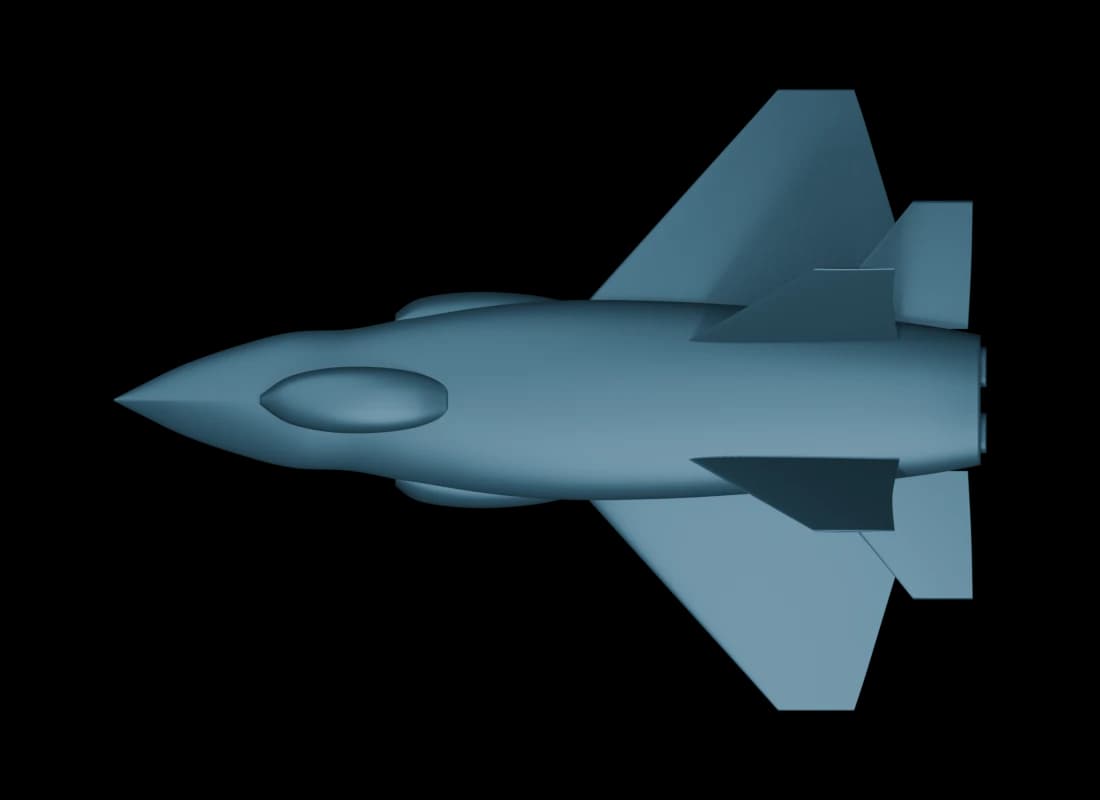
Overview
The F-22A is an air superiority fighter developed for the U.S. Air Force to replace the F-15. It defined the term "fifth generation": before it, stealth (F-117), supercruise (Concorde and some interceptors), and high agility (F-16) existed on separate airframes. The F-22 was the first attempt to fit all three into one aerodynamic configuration — at the cost of a very high unit price and a heavy maintenance burden.
It first flew in 1997 and reached initial operational capability in 2005. The original plan called for 750 aircraft; production ended in 2009 after 187 production airframes, a result of post-Cold War threat reassessment, rising unit cost, and a re-evaluation of how many dedicated air superiority fighters were needed. It has never been lost in air combat, and has never met a peer opponent.
Design
Aerodynamically the F-22 uses a cranked-delta wing with a 42° leading-edge sweep and prominent forebody chines, paired with canted twin fins at 28°. The sharp chine running from the radome to the wing root both generates vortex lift and deflects incoming radar energy into a few narrow directions — stealth and aerodynamics here are two faces of the same design decision.
Two F119 engines drive two-dimensional thrust-vectoring nozzles with ±20° of pitch authority. The rectangular nozzle helps both infrared and radar signature, but costs thrust relative to an axisymmetric design, and is why the F-22 vectors in pitch only.
All primary weapons are carried internally, in a main bay plus two small side bays for short-range missiles. That internal capacity, not the maximum payload figure, is what actually bounds its strike capability in a stealth configuration.
Timeline
YF-22 wins the ATF competition
Selected over the Northrop YF-23 for the Advanced Tactical Fighter programme.
First flight of the F-22A
Initial operational capability declared
The 27th Fighter Squadron became the first combat-capable F-22 unit.
Production terminated
Procurement capped at 187 production aircraft, far below the 750 originally planned.
First combat sortie
Flew its first combat mission during strikes against targets in Syria.
Variants
- YF-222 builtRetired
Two technology demonstrators built for the ATF competition, with noticeably different aerodynamics from the production aircraft.
- F-22A187 builtIn Service
The only variant to enter production, upgraded through the Increment 3.1, 3.2A, and 3.2B avionics and weapons programmes.
- F-22BCancelled
A planned two-seat trainer, cancelled in 1996 as a cost-saving measure. No airframe was built.