MiG-29 (9.13)
MiG-29 Fulcrum
The light half of the Soviet high-low mix — the Su-27 and MiG-29 stand in the same relation as the F-15 and F-16. Excellent in a close-in fight; range was the limitation it never escaped.
- Origin
- Soviet Union
- Status
- In Service
- First flight
- 1977-10-06
- Introduced
- 1983
- Manufacturer
- Mikoyan
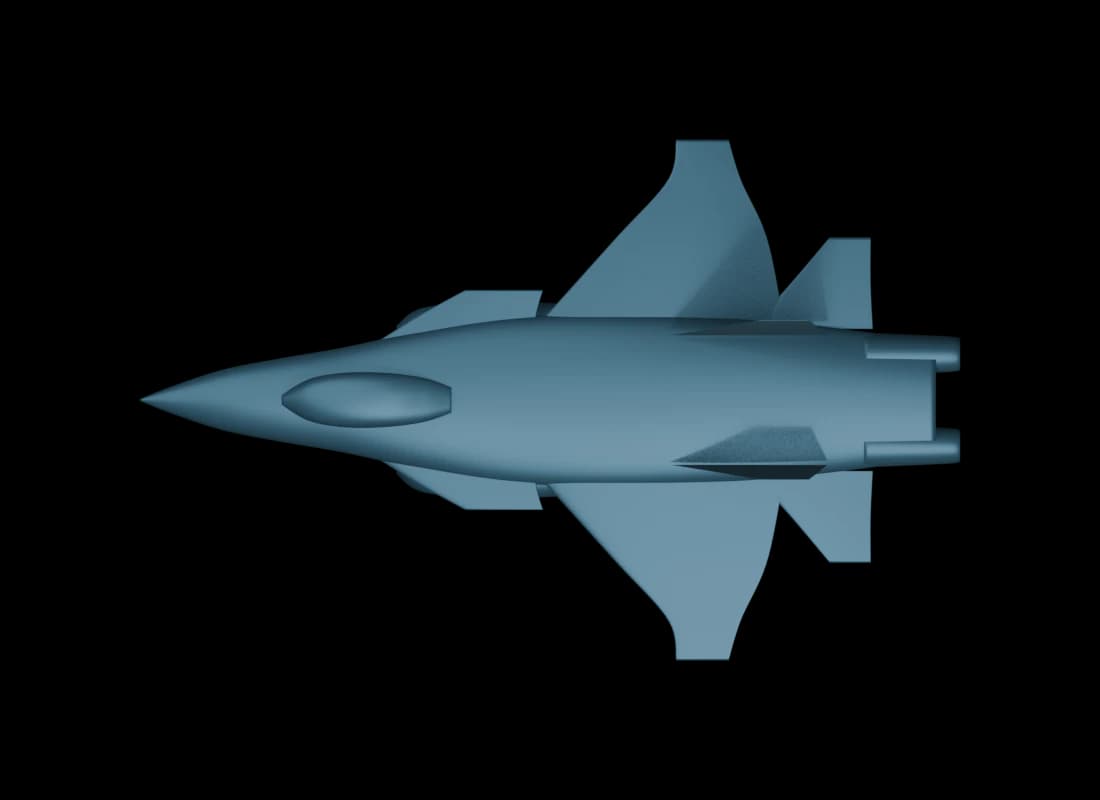
Overview
The MiG-29 and Su-27 came from the same requirement: in the 1970s the Soviet Union concluded it needed a heavy long-range air superiority fighter alongside a light frontal fighter, much as the United States chose the F-15 plus the F-16. Their aerodynamic thinking is closely aligned — widely spaced engines, large leading-edge extensions, twin fins — with the MiG-29 simply a size smaller.
In a close-in fight it performs very well: high thrust-to-weight, strong vortex lift, and a helmet-mounted sight paired with the R-73 missile. NATO confirmed this repeatedly after German reunification, when it inherited East Germany's MiG-29 fleet and flew it against the F-16.
But one limitation it never escaped: internal fuel of only 3.5 tonnes and a combat radius around 700 km. That sufficed for the Central European scenario it was designed around — and outside that scenario its tactical value drops sharply. It is why so many MiG-29s were left idle after the Soviet collapse while the Flanker line kept spawning derivatives.
Design
The most distinctive engineering decision is in the inlets: the main intakes can be closed off entirely during takeoff and landing, with air drawn instead through louvres on the upper wing surface. This prevents foreign-object ingestion when operating from unpaved strips — a requirement no contemporary Western fighter considered, and a direct reflection of different expectations about wartime airfield conditions.
Cockpit visibility is another clear gap. The MiG-29's canopy has more framing and a lower seat, giving rearward vision far short of the F-16's bubble. In a visual fight that is a real disadvantage.
The N019 radar is limited by nose aperture, with detection range and multi-target capability well below the Su-27's. A light fighter's compromises in sensors are harder to offset than its compromises in aerodynamics — already visible in this generation, and more pronounced in the fifth.
Timeline
Prototype first flight
Enters service
Farnborough debut
Its first public display in the West; the high-alpha manoeuvring drew wide attention.
NATO inherits the East German fleet
The West could evaluate and fly against the type for the first time, turning assessments from speculation into evidence.
MiG-35 deliveries begin
A deeply upgraded variant with an AESA radar, though orders have been very limited.
Variants
- MiG-29 (9.12)Retired
The earliest production standard; export aircraft had simplified avionics.
- MiG-29 (9.13)In Service
A dorsal spine housing additional fuel, partially easing the range shortfall.
- MiG-29KIn Service
Folding wings and strengthened landing gear, for Russian and Indian carriers.
- MiG-35Limited Service
Re-equipped with an AESA radar and new engines. Orders have been very limited and it has not reached scale.