Rafale C
Dassault Rafale
France's solo canard-delta multirole fighter. "Omnirole" was a design constraint, not marketing — one fleet had to cover nuclear deterrence, carrier operations, and the full conventional spectrum.
- Origin
- France
- Status
- In Service
- First flight
- 1991-05-19
- Introduced
- 2001-05-18
- Manufacturer
- Dassault Aviation
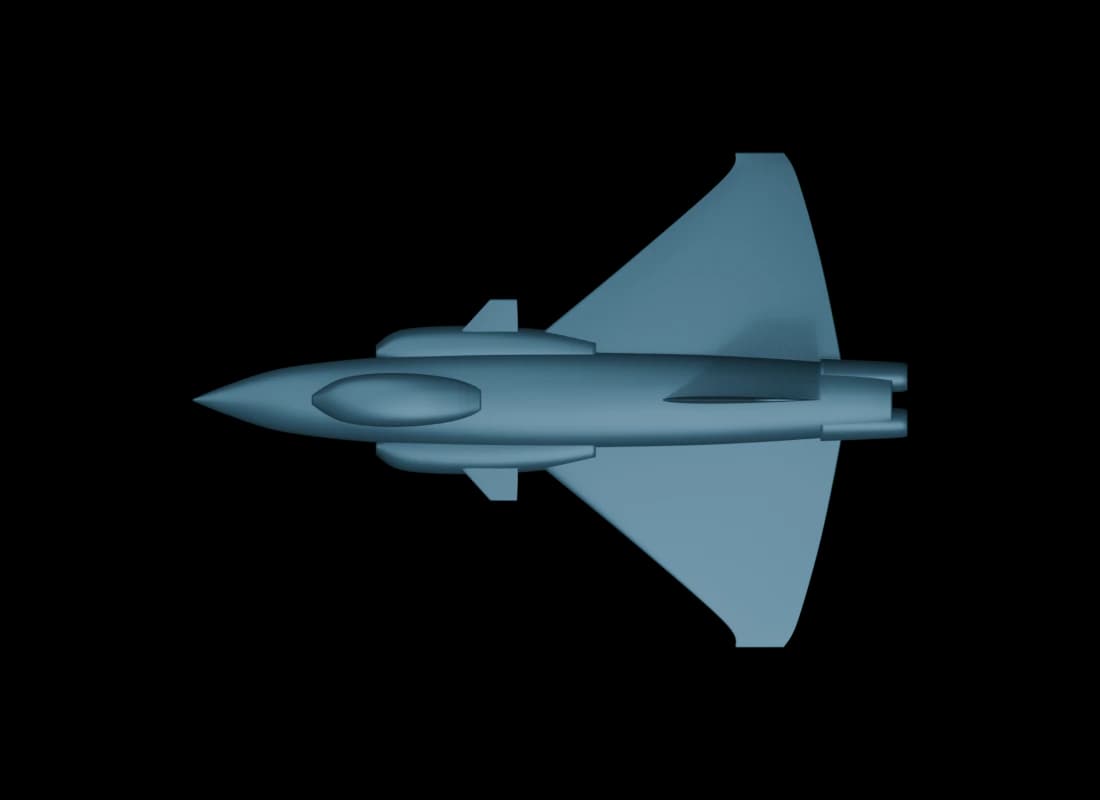
Overview
France left the European joint fighter programme in 1985, unwilling to accept another nation's leadership or a design that did not meet its carrier requirement. Dassault then completed the Rafale alone — the only European country of its generation to do so.
The Rafale's core design constraint was not any performance figure but covering every mission of both the French air force and navy with one airframe: air superiority, strike, reconnaissance, anti-shipping, and above all airborne nuclear deterrence. The French defence budget could not sustain multiple specialised fleets, so "omnirole" was forced rather than chosen.
That constraint produced some distinctive outcomes. It was the first European fighter of its generation to field an AESA radar (the RBE2-AA, in 2012), because multirole work demands the most from sensors. Its top speed is only Mach 1.8, below the Typhoon's, because high Mach performance has the least marginal value across its mission set.
Design
The canards are close-coupled — set just ahead of the wing and close to its height. The canard vortex sweeps directly over the wing's upper surface, adding significant lift at high angles of attack, at the cost of a short moment arm and less trim authority than the Typhoon's long-coupled arrangement.
That single difference runs through both aircraft's character: the Typhoon's canards serve altitude, speed, and trim efficiency; the Rafale's serve low-speed high-alpha handling and short-field performance — the latter a necessity for carrier operations. The same aerodynamic element, positioned differently, serves opposite goals — the most useful way into understanding Europe's two canard deltas.
The inlets are fixed semicircular units with no variable ramps. That directly caps top speed but saves weight, cost, and maintenance hours. Under a budget that requires one aircraft to do everything, it is a rational trade.
Timeline
France withdraws from the European programme
Over leadership and carrier requirements, moving to independent development.
Rafale A demonstrator first flight
Rafale C first flight
Carrier variant enters service first
The navy variant preceded the air force's, reflecting the priority carrier requirements held throughout the programme.
RBE2-AA AESA fielded
Variants
- Rafale CIn Service
The French air force single-seat standard.
- Rafale BIn Service
The two-seater, and the primary configuration for the airborne nuclear deterrent role.
- Rafale MIn Service
Strengthened gear and arrestor hook for the Charles de Gaulle — the requirement the whole programme originally split over.