Su-27S
Su-27 Flanker
The Soviet heavy air superiority fighter built to counter the F-15. Its integrated aerodynamic layout and enormous internal fuel made it the most prolifically derived fourth-generation platform.
- Origin
- Soviet Union
- Status
- In Service
- First flight
- 1981-04-20
- Introduced
- 1985
- Manufacturer
- Sukhoi
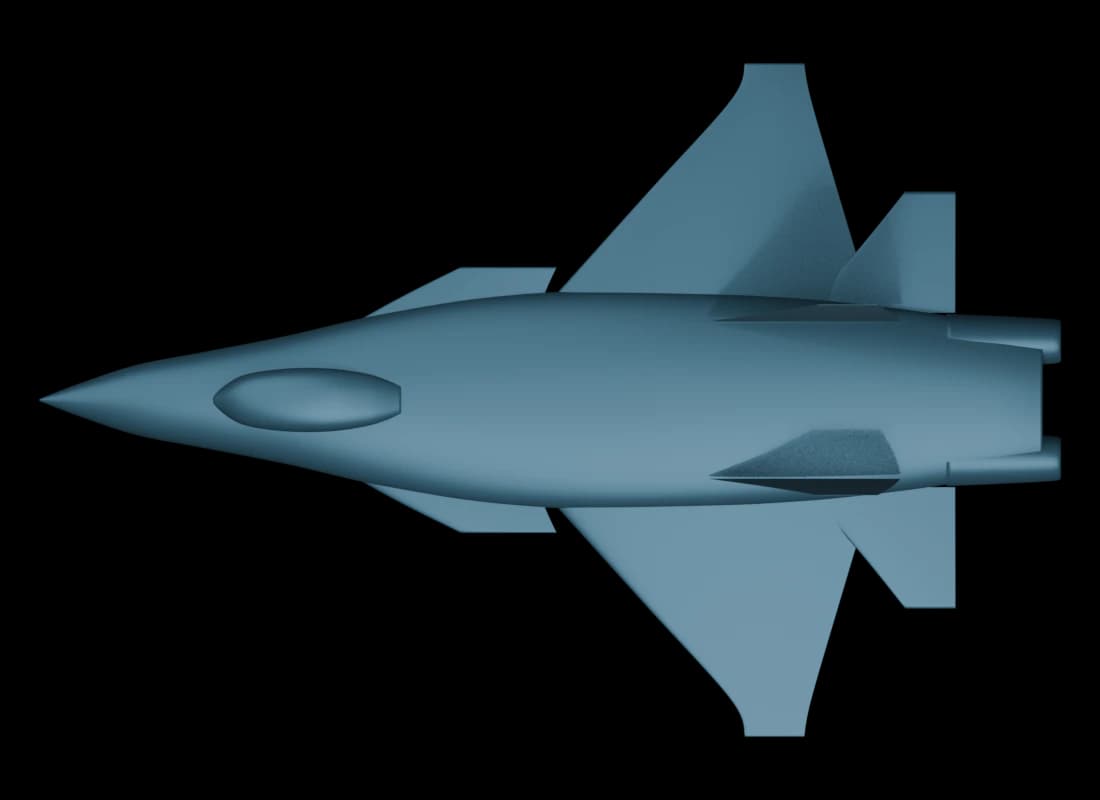
Overview
The Su-27 came out of the Soviet Union's 1970s "future frontline fighter" requirement, aimed squarely at the American F-15. The first T-10 prototype flew in 1977, but testing exposed serious aerodynamic and structural problems, and Sukhoi did something rare for the era: started over. The T-10S that flew in 1981 was very nearly a new aircraft — and became the Su-27.
Its downstream influence may exceed that of any other fourth-generation fighter. The J-11, Su-30, Su-33, Su-34, and Su-35 all descend from this airframe, and the Su-57's central lifting body continues the same line of thinking. Derivatives remain frontline equipment in China, India, and Vietnam today.
Design
The integrated aerodynamic layout is the Su-27's defining idea: wing and fuselage have no clear boundary but blend into one continuous lifting surface, with two widely spaced engines and a fuselage section between them that itself generates lift. That thinking passed directly to the Su-57.
Vortex lift from large leading-edge extensions keeps it controllable at high angles of attack; combined with relaxed static stability and fly-by-wire, it produced post-stall manoeuvres such as Pugachev's Cobra. Those have limited combat value, but they do reflect genuine control margin in the low-speed, high-alpha regime.
Internal fuel reaches 9.4 tonnes, giving a combat radius far beyond the contemporary F-16 at the cost of much greater empty weight and size. The mechanically scanned N001 radar has a large aperture and long detection range, but its multi-target capability lagged Western sets of the period — a general weakness of Soviet electronics, and the main thing later Flanker variants set out to fix.
Timeline
T-10 prototype first flight
Testing revealed serious aerodynamic and structural problems; performance fell short of requirements.
Redesigned T-10S first flight
Sukhoi abandoned the original design and started again. The T-10S was nearly a new aircraft, and became the production Su-27.
Enters service
Public debut at the Paris Air Show
Viktor Pugachev flew the manoeuvre later named after him, giving Western observers their first direct look at its high-alpha control.
J-11 production begins in China
The start of licensed production, from which an entire Chinese heavy-fighter lineage followed.
Variants
- T-10Cancelled
The original design flown in 1977, abandoned wholesale after falling short of requirements.
- Su-27SIn Service
The baseline aircraft and the air superiority mainstay of the Soviet and Russian air forces.
- Su-27UBIn Service
A tandem two-seater retaining full combat capability, and the basis for later multi-seat derivatives.
- Su-30 / Su-33 / Su-34 / Su-35In Service
Developed for multirole, carrier-borne, strike-fighter, and enhanced air superiority roles respectively. The Su-35S is treated as a separate entry.
- J-11In Service
Beginning with kit assembly and progressively localised, spawning the J-11B and J-16 among others.