Su-57
Su-57 Felon
Russia's first fifth-generation fighter. Its aerodynamics and agility are widely respected; its stealth is where assessments diverge most sharply.
- Origin
- Russia
- Status
- Limited Service
- First flight
- 2010-01-29
- Introduced
- 2020-12
- Manufacturer
- Sukhoi
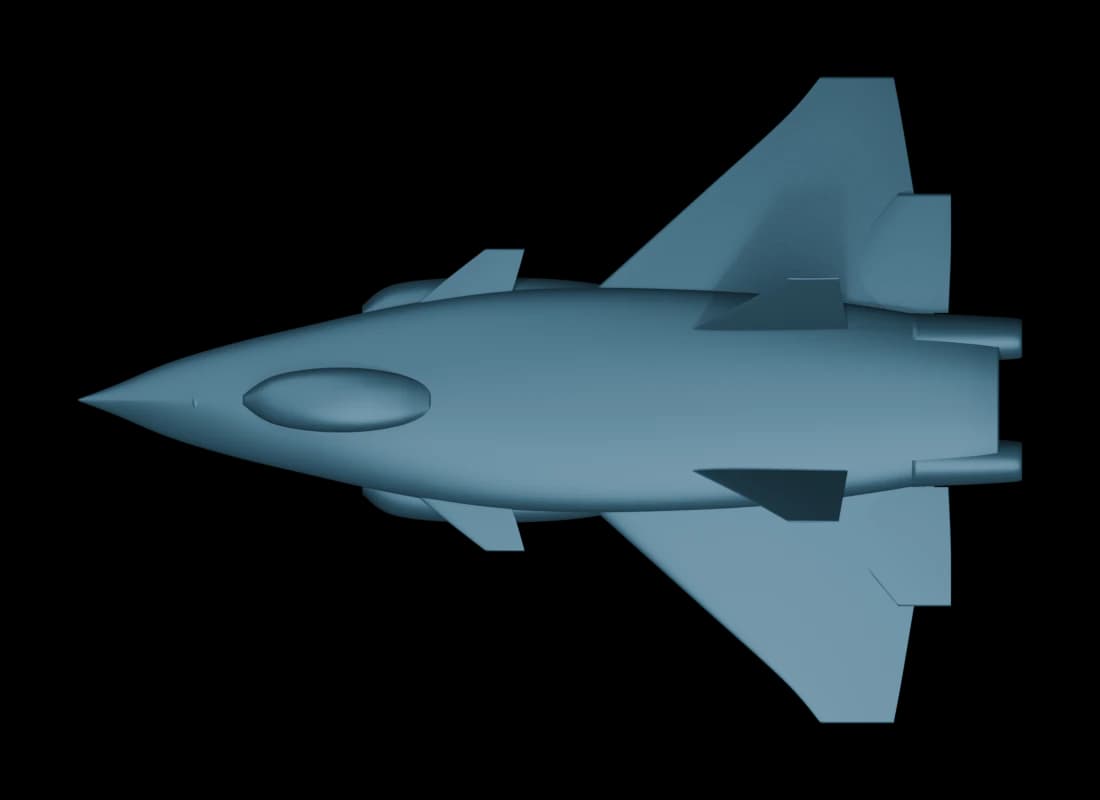
Overview
The Su-57 grew out of the PAK FA programme launched in the early 2000s, first flew as the T-50 in January 2010, and saw its first series aircraft delivered in December 2020. The number in service remains small — a reflection less of the design than of Russian aerospace industrial capacity and funding.
Compared with the F-22, the Su-57 takes a different route: widely spaced engines, a flat central lifting body, movable leading-edge control surfaces, and three-axis thrust vectoring. That combination ranks agility and range very highly, while visibly compromising on the thoroughness of the stealth treatment — exposed engine fan faces, gaps around the movable LEVCONs, and variable inlets are all conventional-layout traits.
This is exactly where assessments diverge: whether those compromises are a pragmatic trade or a shortfall in capability is answered very differently by Russian and Western sources. Both readings are presented here; the conclusion is left to the reader.
Design
The central lifting body is the Su-57's defining aerodynamic feature. The broad, flat fuselage section between the widely spaced engines generates significant lift, giving lower wing loading at a given takeoff weight. Its 14.1 m span is the largest of the four fifth-generation fighters in service, and combined with movable leading-edge surfaces (LEVCONs) gives it exceptional high-alpha controllability — the reason it can perform post-stall manoeuvres at air shows.
The LEVCON sits between a canard and a fixed strake: it controls vortex flow and improves low-speed handling without presenting the strong forward radar return of an all-moving canard. It is the Su-57's own solution to the problem.
Three-axis vectoring nozzles retain yaw authority that the F-22's two-dimensional nozzles give up, raising the manoeuvre ceiling at the cost of a harder-to-suppress infrared and radar signature — another instance of agility ranked ahead of stealth.
Timeline
T-50 first flight
Officially designated Su-57
Deployed to Syria
Two prototypes deployed briefly, widely assessed as a test and demonstration rather than combat employment.
First series aircraft lost
Crashed during a pre-delivery test flight, delaying the first delivery by a year.
First series aircraft delivered
Variants
- T-50Retired
Test aircraft from the PAK FA phase; more than ten were built, with aerodynamic details differing from production standard.
- Su-57In Service
The in-service standard, powered by the AL-41F1. Plans to re-engine with the izdeliye 30 have not been confirmed in the fleet.
- Su-57EIn Development
An export configuration promoted at air shows; no confirmed deliveries to date.