Typhoon FGR4
Eurofighter Typhoon
A four-nation canard-delta fighter with very low wing loading and outstanding climb and altitude performance — bought with two decades of political coordination and the cost that came with it.
- Origin
- United Kingdom · Germany · Italy · Spain
- Status
- In Service
- First flight
- 1994-03-27
- Introduced
- 2003-08-04
- Manufacturer
- Eurofighter GmbH (BAE Systems, Airbus, Leonardo)
Overview
The Typhoon was developed jointly by the United Kingdom, Germany, Italy, and Spain, first flying in 1994 and entering service in 2003. The near-twenty-year gestation from the 1983 programme launch was driven less by technology than by repeated bargaining over requirements, workshare, and funding. France left in 1985 precisely because it could not accept another nation leading, and developed the Rafale alone.
Politics aside, the aerodynamics are excellent: a 51.2 m² delta on an 11-tonne empty weight gives very low wing loading, and two EJ200s give a thrust-to-weight ratio near 1.15 with supersonic cruise without afterburner. Among 4.5-generation fighters its climb rate and high-altitude intercept performance are close to unmatched — which was exactly the original British and German requirement: intercepting bomber formations from the east.
That requirement disappeared with the Cold War, and the Typhoon's air-to-ground capability was only filled in progressively a decade into service — the direct reason it trailed the Rafale in multirole capability for years.
Design
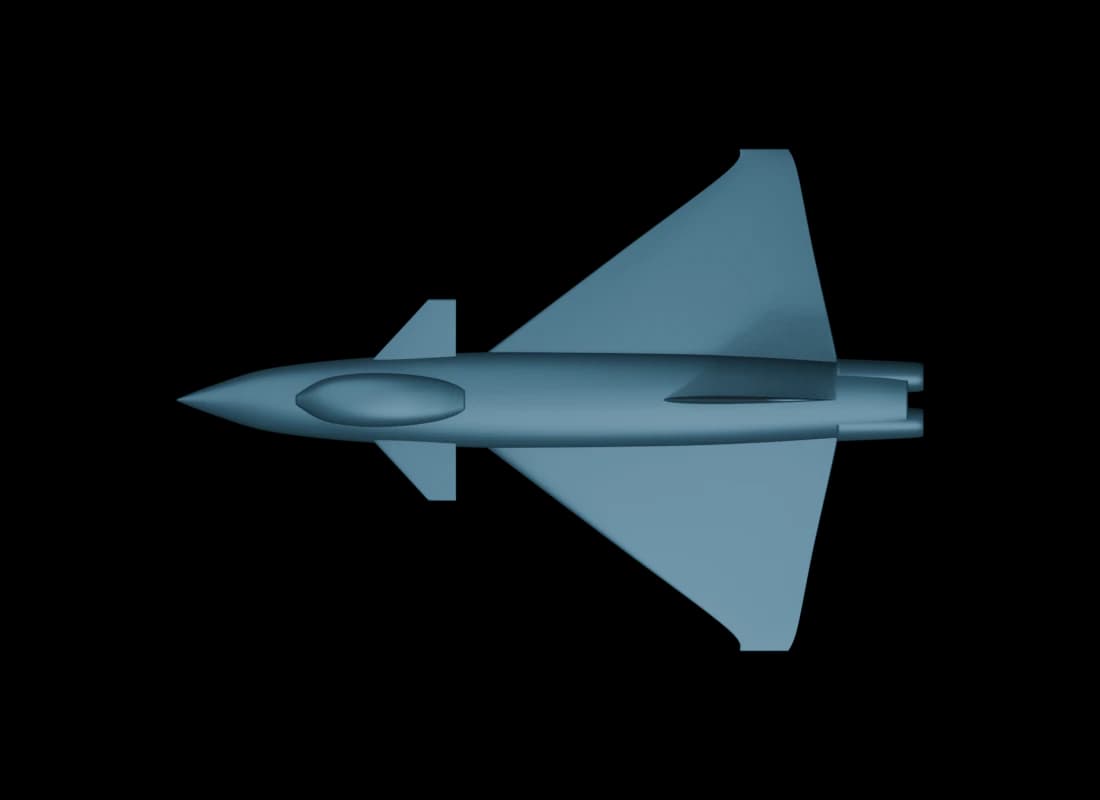
Canard position is the most direct way to tell a Typhoon from a Rafale. The Typhoon's canards sit well ahead of the cockpit and high — a long-coupled arrangement. The long moment arm gives high trim authority, allowing the aircraft to be designed substantially unstable; but the canard vortex sheds too far from the wing to add much lift over it.
That is a different philosophy from the Rafale's close-coupled canards: the Typhoon prioritises trim efficiency and supersonic performance, the Rafale high-alpha lift. Neither is more "correct" — they encode different judgements about mission profile by two air forces.
Radar was the Typhoon's long-standing weakness. It entered service with the mechanically scanned CAPTOR-M; the CAPTOR-E AESA only began fitting in the late 2010s, nearly a decade after the Rafale's RBE2-AA. The coordination cost of upgrade decisions in a multinational programme shows clearly here.
Timeline
Future European Fighter Aircraft programme launched
France withdraws
Left over leadership and carrier requirements, developing the Rafale alone. Europe has had two same-generation fighters ever since.
First flight
Delivered to operational units
First combat over Libya
Variants
- Tranche 1Reserve
Initial production with limited air-to-ground capability; some airframes have retired or moved to training.
- Tranche 2/3In Service
Filled in multirole capability, progressively adding the AESA radar and Meteor missile. The frontline standard.