Leopard 2A7
Leopard 2A7
The most widely exported Western main battle tank. Its design converges closely with the M1A2's, except on propulsion — where it took the other road, and the other road turned out to be right.
- Origin
- Germany
- Status
- In Service
- Introduced
- 2014
- Manufacturer
- Krauss-Maffei Wegmann
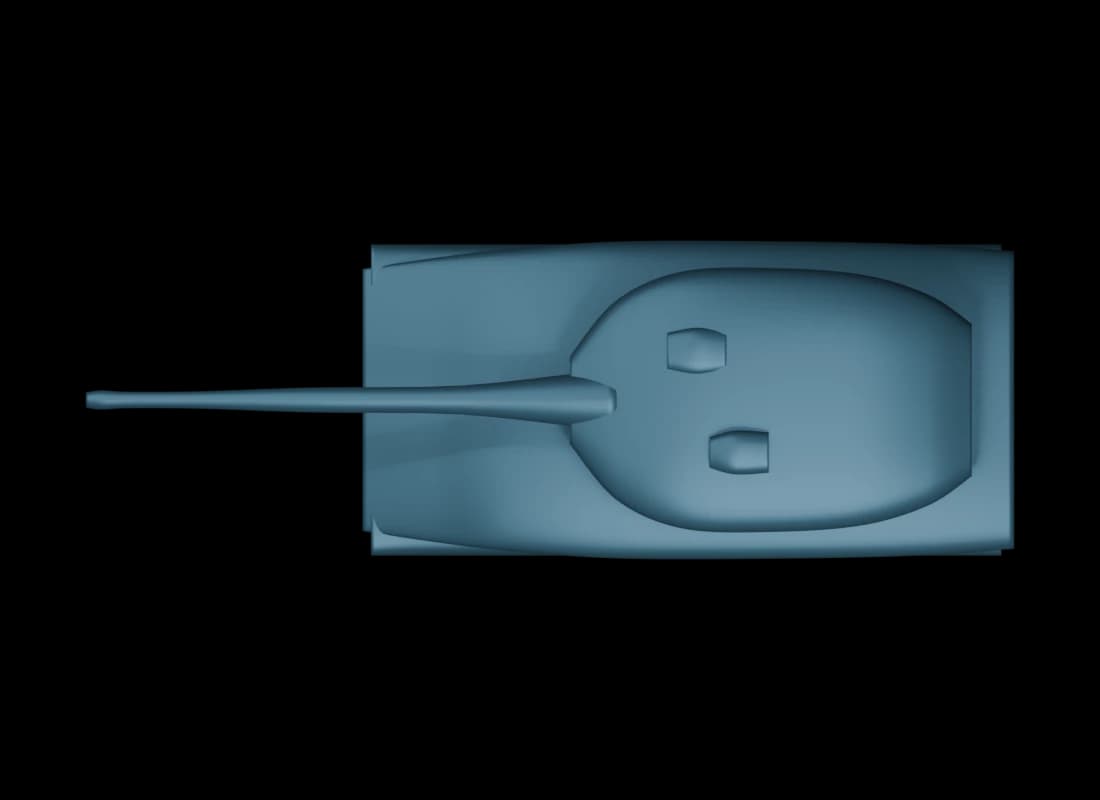
Overview
The Leopard 2 entered service in 1979; the 2A7 is the current standard from 2014. It was designed and fielded alongside the M1A2, uses the same 120 mm smoothbore (the M1A1's M256 is a licensed Rh-120), and converges closely on crew size, ammunition isolation, and armour philosophy.
The one fundamental difference is propulsion: the Leopard chose a 1,500 hp MTU diesel where the M1 chose a turbine of the same power. Thirty years on, the diesel's logistical advantage is decisive — greater range on the same fuel, idle consumption a fraction of a turbine's, and a maintenance chain shared with other military vehicles. The U.S. Army is still paying for the M1's fuel appetite.
It is also the most successfully exported Western tank, in service with more than eighteen countries. That is not purely a performance question: German export policy and industrial cooperation terms were for a long time more flexible than American ones, and for most buyers that mattered more than tens of millimetres of armour equivalence.
Design
The L/55 barrel, introduced with the 2A6, is the signature change. At 1.3 m longer than the M1A2's L/44 it raises muzzle velocity and penetration — lengthening the barrel is the most direct way to improve armour penetration at a given calibre — at the cost of overhang, balance, and manoeuvring in built-up areas.
Ammunition follows the same logic as the M1: main stowage in a turret bustle behind an armoured bulkhead with blow-off panels. That is the common Western third-generation choice and the sharpest divergence from the T series.
The 2A7 adds an urban operations package: all-round passive armour, a remote weapon station, and an auxiliary power unit. Almost all of it targets asymmetric conflict rather than large-scale armoured warfare, reflecting the operational assumptions of the 2010s — which the war in Ukraine then forced back under review.
Timeline
Leopard 2 enters service
2A6 adopts the L/55 barrel
A 1.3 m longer barrel with a marked gain in penetration.
2A7 delivered
Urban operations package, remote weapon station, and auxiliary power unit.
First large-scale high-intensity combat
Employed in Ukraine, exposing Western third-generation tanks' vulnerabilities in an environment saturated with drones and anti-tank missiles.
Variants
- Leopard 2A4In Service
The most widely exported standard, still in use and locally upgraded by many operators.
- Leopard 2A6In Service
Fitted with the L/55 barrel.
- Leopard 2A7In Service
Urban operations package and new electronics.